

Smart Security · London, Ontario
See the entrances. Manage access with clarity.
Think through entrances, visibility and access together, with compatible devices selected for your property and preferences.
Or call +1 (226) 236-6286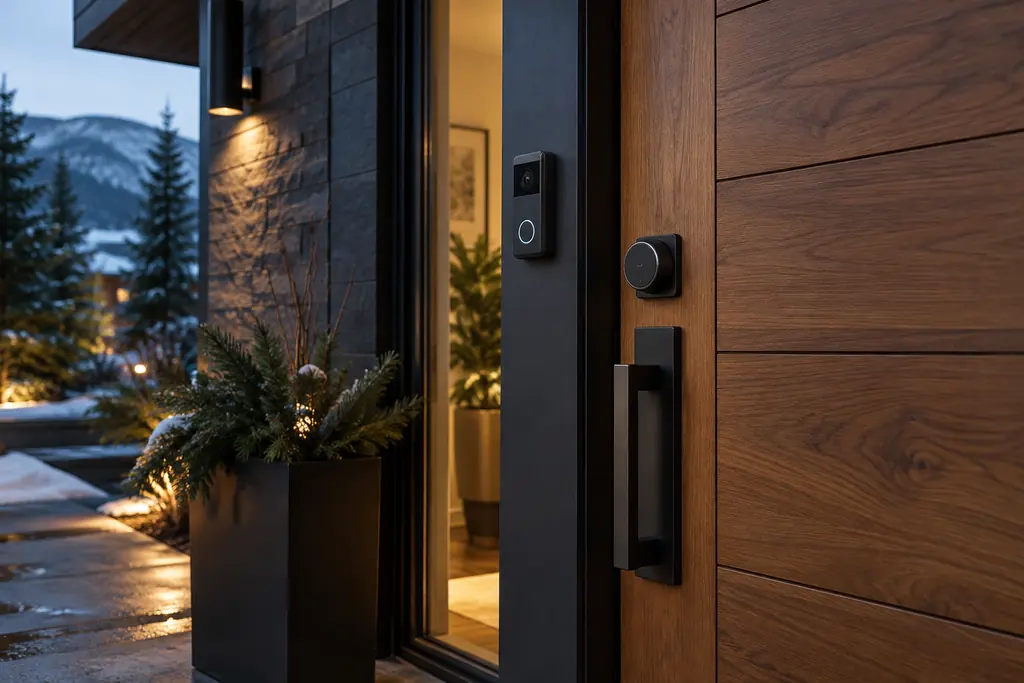
A practical starting point
What we can plan together
We’ll discuss placement, power, Wi-Fi coverage, recording options and who should manage access. Specific devices and monitoring features depend on your property and the integrations you choose.
- Cameras and video doorbells
- Smart locks and managed access codes
- Door and motion sensors with useful alerts
Devices & systems
What we can connect
What we’ll check: Camera placement, power, connectivity, recording options and who can access the system.
- 01
Doorbells & cameras
See activity at the areas that matter to you.
- 02
Smart locks
Manage access through supported controls.
- 03
Door & motion sensors
Trigger a chosen routine or a compatible alert.
Examples only. Final products and scope are selected for your space.
No surprises
What installation involves
- PoE cameras: one Cat6 cable each for power and video, weather-sealed outdoors.
- A recorder in the network cabinet keeps footage on site; cloud backup is optional.
- Uses the existing doorbell wiring if the transformer is up to the job (most video doorbells need 16–24 V AC; an undersized transformer is replaced by a licensed electrical contractor), or a battery model.
- Smart locks fit most standard deadbolt preps; the door’s alignment is checked first.
- Ontario law requires a working smoke alarm on every storey and outside all sleeping areas. Homes with a fuel-burning appliance, a fireplace or an attached garage also need a CO alarm next to each sleeping area and, since January 1, 2026, on every storey.
By the numbers
- up to 10%
off home insurance with a centrally monitored fire and burglar alarm at some insurers — Desjardins, for example.
Desjardins Insurance - 40%+
of all Allstate Canada home insurance claims from 2021 to 2025 were water damage — leak sensors and automatic shut-off valves catch it early.
Allstate Canada - Every storey
needs a CO alarm in Ontario homes with fuel-burning appliances, a fireplace or an attached garage, as of January 1, 2026 — plus beside each sleeping area.
Government of Ontario
Published averages and survey results, not guarantees for your property. Sources checked October 2026.
From first call to connected space
Thoughtful at every step.
Device compatibility, integrations and project scope are confirmed for each property. Examples describe possibilities, not guaranteed outcomes.
- 01
Consult
A free phone conversation about your space, your priorities and what you already own.
- 02
Assess
On site: wiring, Wi-Fi coverage, doors, heating and cooling, and existing equipment — measured, not guessed.
- 03
Design
A written plan and itemized proposal: every device, every cable run and what each part does for you.
- 04
Install & connect
Network first, then devices. Licensed trades handle any regulated electrical work.
- 05
Program & test
Scenes and routines set up, then every system tested: coverage, recording, alerts and manual overrides.
- 06
Hand over & support
A walkthrough, documentation and a manual-override guide, with optional monthly or annual support.

Your free first step
Start with a conversation.
Tell us what you’re working with and what you’d like to improve.